
.jpg?width=300&name=EuroShop%20Flink%20(1).jpg)
EuroShop in Düsseldorf is more than just a trade fair – it's a global epicentre for the future of retail. As one of the industry's key drivers of innovation in retail technology, it provides the perfect stage to explore the operational excellence behind modern commerce.
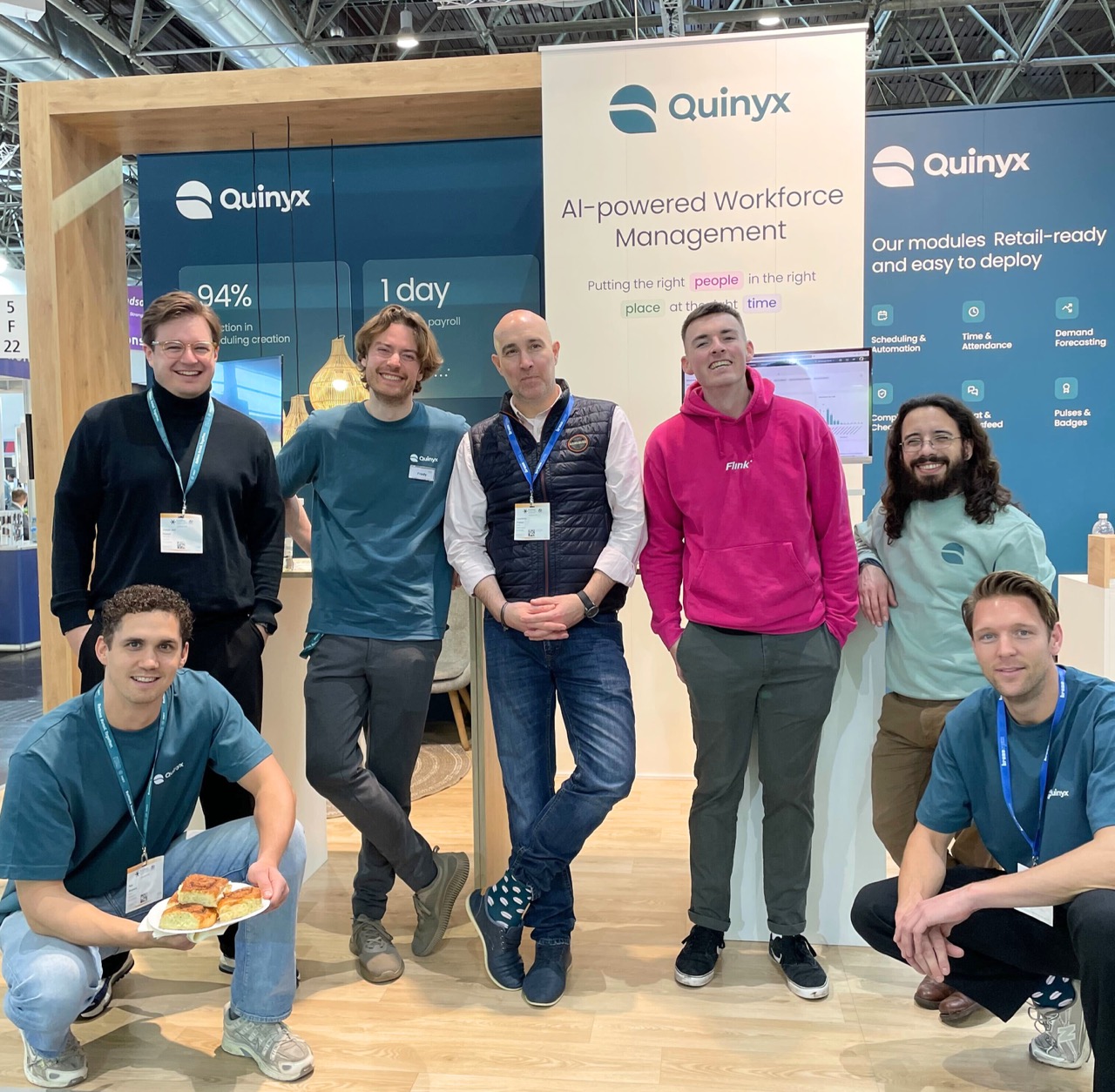
In the session "From Schedules to Strategy," Nico Felder (Principal Workforce Planning & Performance) and Gaston Barboza (Automation Engineer) from Flink joined Laurence Painell (CPO) from Quinyx to discuss how the quick-commerce delivery service leveraged workforce management (WFM) and AI to successfully launch up to ten new locations per week during periods of hypergrowth.
The Challenge: Scaling under High Pressure
In quick commerce, time is the most valuable currency. For Flink, this meant ensuring that nearly 100 cities, 160 warehouses, and more than 10,000 employees operated seamlessly. But how do you scale such a model when the original planning processes were decentralised and largely manual?
During its hypergrowth phase, Flink opened up to ten hubs per week. Nico Felder emphasised that relying on manual processes at this pace not only slows operations but also introduces significant operational risk:
"We needed a solution that was data-driven and flexible, yet simultaneously complied with strict labour laws – especially in an industry that is heavily scrutinised politically."
Nico Felder | Flink
Gaston Barboza described the situation before partnering with Quinyx: each hub manager created their schedules manually and locally. This process was inefficient and posed significant risks to compliance with complex working-time laws. The goal was clear: a Workforce Management solution that enables data-based, central decisions without losing the crucial "local touch" on site. Quinyx served as the technological backbone, shifting the administrative burden from branches to automated, efficient WFM processes.
Compliance as a Strategic Statement
A key topic of the session was the perception of quick commerce. Nico Felder highlighted that the industry is often scrutinised regarding occupational safety. Flink consciously chose a different path: absolute compliance as its distinguishing feature.
By automating regulatory frameworks within Quinyx, Flink ensures that all Riders and Hub employees work within the legal requirements. This is not only a matter of legal certainty but also a crucial part of the Employer Value Proposition in a market with high fluctuation.
Employee Experience: Flexibility via App
Gaston Barboza and Nico Felder emphasised that the intuitive usability of Quinyx was key to its acceptance on the floor. For employees, this specifically means:
- Onboarding & Availability: New employees can be quickly integrated and easily submit their availability.
- Self-Service: Functions like independent shift swapping give employees control over their work-life balance while simultaneously relieving managers.
The Technological Architecture: AI and Agentic AI
Laurence Painell explained how Quinyx supports this transformation through a multi-layered AI approach:
- Historical data feeds demand forecasting models to accurately align staffing levels with actual order volumes.
- Algorithmic Optimisation: Advanced algorithms automatically generate optimised schedules while respecting all operational rules and regulations.
- Agentic AI & LLMs: The newest layer enables employees to access internal documents and policies using natural language queries (e.g., "How do I book my vacation?"), simplifying communication between headquarters and operations.
The Next Step: Task Management
Gaston Barboza also shared a preview of upcoming developments: integrating operational tasks directly within the hubs. Laurence Painell confirmed that Quinyx is already working on the next generation of task management.
The vision is seamless automation, where operational tasks are assigned with the same precision and automation as employee shifts. Flink's journey demonstrates one thing clearly: workforce management today is far more than just scheduling.