- 2 min reading
Compliance is about more than avoiding fines or meeting legal requirements. It helps protect the frontline employees behind every schedule, supporting fair working hours, proper rest, and a healthier work-life balance.
Yet there is a gap between identifying a violation and addressing it: 93% of compliance violations raised during scheduling get overridden rather than resolved.
When violations remain unresolved, businesses can face compliance risks that are difficult to track – from potential fines and legal disputes to audit findings and lost employee trust.
Closing that gap starts with giving planners a clearer way to review and resolve violations before schedules are published.
Why scheduling violations get overridden
Warnings alone do not give planners everything they need to manage compliance. Several workflow challenges can make violations harder to address.
Warnings interrupt the planning process
Compliance warnings appear while planners are building schedules, often as they balance staffing needs, employee availability, and operational demands.
When critical rules are configured as soft warnings rather than hard stops, planners may also struggle to distinguish violations that need immediate attention from those they can review later.
Dismissing a warning can feel like the quickest way to keep working, with the intention of returning to it. Without a clear review step, however, that follow-up is easy to miss.
Overridden violations are difficult to track
Once a warning is dismissed, planners need a reliable way to find the underlying violation again.
Without a dedicated, up-to-date view, they may have to search individual shifts or rely on reports that do not reflect the current schedule. That makes it harder to understand which violations remain open and where to focus attention.
Manual checks create more work
When violations are scattered across shifts and reports, reviewing them becomes a time-consuming task.
Planners spend more time checking schedules and correcting violations, adding pressure to an already demanding role and leaving less time for proactive planning.
These challenges point to a gap in the workflow: planners need a consistent way to track, review, and resolve violations alongside their scheduling work.
Violations Panel: a clearer view of schedule compliance
Quinyx’s Violations Panel brings scheduling violations into a dedicated side panel within the scheduling view. Planners can see what needs attention and make changes without leaving the schedule.
It creates a clear review step between building a schedule and publishing it, helping teams address violations while there is still time to act.
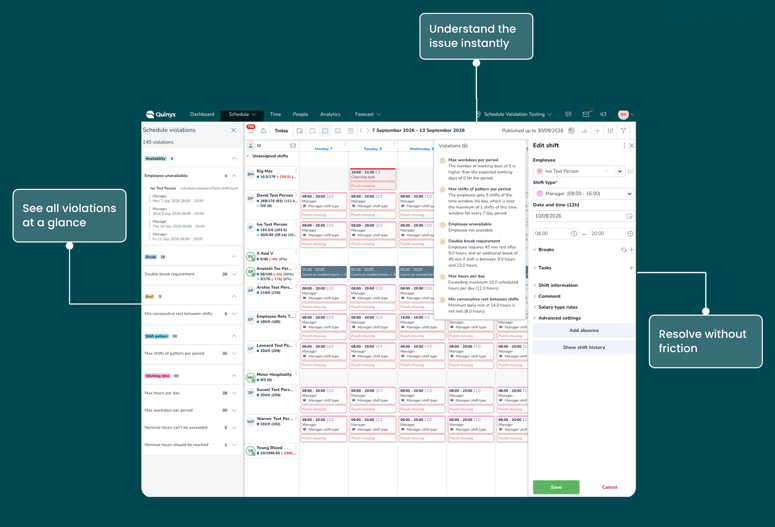
With Violations Panel, planners can:
- Keep planning in context: Review violations alongside the schedule they are working on.
- See violations in one place: Identify affected shifts across the schedule without searching through separate tabs and reports.
- Understand what needs attention: See the type and number of violations associated with each shift.
- Resolve violations efficiently: Make changes directly within the scheduling view.
- Review compliance before publishing: Check for remaining violations before sharing the schedule with employees.
For HR, operations, and compliance leaders, this supports:
- Earlier action on compliance risk: Give planning teams visibility of violations before schedules are published.
- More consistent reviews: Make compliance checks a defined part of the scheduling process.
- Less manual work: Reduce the need to search individual shifts and move between tools.
- Better support for planners: Help teams spend less time on reactive checks and more time building effective schedules.
A connected approach to workforce compliance
Identifying a violation is only the first step. Teams also need to resolve it and understand compliance patterns across their operations.
Quinyx’s compliance capabilities support each part of that process:
- Schedule Validation checks schedules against configured rules for working hours, rest, breaks, and skills as planners build them, helping teams identify violations early.
- Violations Panel brings remaining scheduling violations into a dedicated view, helping planners review and resolve them before publishing.
- Compliance Checker brings compliance data from multiple sites into a single report, helping leaders identify patterns, prioritise action, and support compliance reviews.
Together, these capabilities help make compliance a more consistent part of workforce planning—from checking individual shifts to reviewing risk across locations.
For organisations managing complex workforces, that means clearer visibility, more focused action, and greater confidence in the scheduling process.
Understand compliance requirements in your region
Workforce compliance requirements vary by country, industry, and collective agreement.
Explore our workforce compliance report to understand how requirements differ across regions and how Quinyx’s compliance capabilities can support local workforce planning.