-
Quinyx named a Leader in the 2026 Gartner® Magic Quadrant™ for Workforce Management Technology


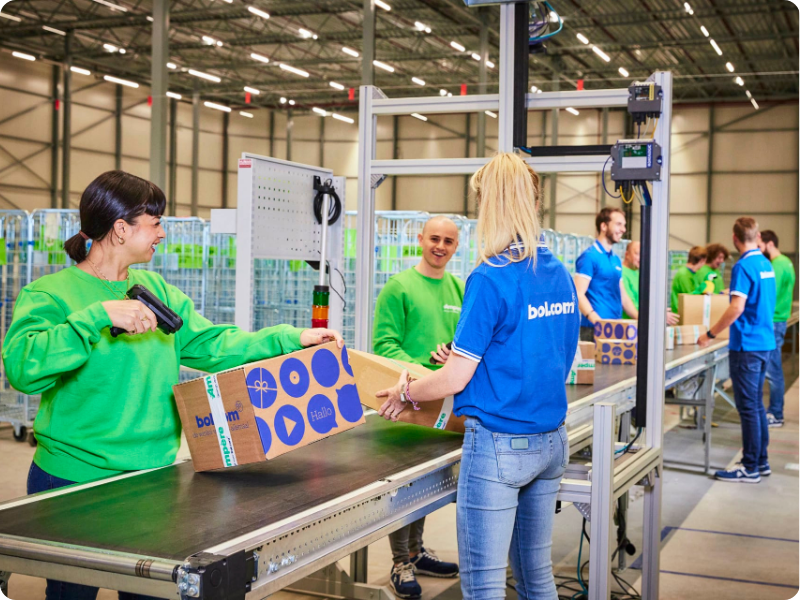
Bol.com is the largest online marketplace in the Netherlands and Belgium. Ampère is the logistics arm it set up to collect parcels from bol partners – the sellers on the platform – and deliver them on the last mile to the customer. Ampère now employs 1,500 people – and 80% of all shifts are scheduled fully automatically, without hiring a single extra operational planner.
At many companies, IT is a supporting department; at Ampère, it's the engine of the operation. Sustainability isn't an afterthought: 97% of collection routes run on biofuel, and the entire last-mile fleet is electric. Ampère started in 2022 as a bol.com project, with one simple brief: build a working operation with in-house IT within six months. That happened – and it wasn't easy.
The challenge: from start-up to scale-up, without breaking the staff schedule
In three years, Ampère grew from 2 to 6 depots and from 100 to 1,500 employees, while daily parcel volume rose from 6,000 to 100,000. What started as a collection service in a handful of regions is now a nationwide network with 85% last-mile coverage.
That growth didn't come easily. Scheduling stayed largely manual, while employees constantly joined and left, new propositions were added and the number of shifts kept climbing. On top of that came the everyday headaches: shift swaps, no-shows and employees with increasingly specific requests.
The team read demand per depot and proposition from Ampère's internal system, then transferred it to Quinyx by hand: adjust the base schedule, roll it out, then assign shift after shift. At some point that process hit its limits – could it keep scaling, was there enough validation between what was planned and what actually happened, and how dependent was everything on a handful of individual planners, while the rest of the organisation had barely any visibility into what was going on?
The solution: rebuilding the planner, not just the schedule
Ampère decided to fully automate internal scheduling. Creating shifts based on predefined demand is relatively simple; almost any system can do that. The harder question that followed: how do you rebuild the work of an operational planner, including all the judgement calls someone with experience makes almost automatically?
The answer came in two parts: Auto Schedule and Auto Assign, the building blocks of Quinyx Optimise. Auto Schedule handles the integration and creation of shifts between Ampère's internal system and Quinyx, and Auto Assign then assigns those shifts based on rules Ampère set itself.
Some rules are non-negotiable: the right skills, sufficient rest between shifts, a cap on working days and shift length, and a shift moving to the right section when needed. Other rules carry weight but flex with the situation – minimum and maximum contract hours, a fair split of standby and Sunday shifts, priority for evening shifts, prioritisation by section and by employee.
That fairness turned out to be the hinge: once standby, Sunday and evening shifts were split fairly, employees and planners started trusting the automated assignment.
The result: full control, without extra planners
With Ampère's internal system directly connected to Quinyx, there's no gap left between what's on paper and what happens in the depots. The schedule is the execution.
Headcount grew tenfold, without a single extra operational planner joining the team. Ampère keeps full control of its own scheduling – no third party sitting in between. And of all shifts, roughly 2,500 a week, around 80% are scheduled fully automatically, with nobody needing to check.
“We decided to fully automate our scheduling. Creating shifts based on demand, that's the easy part. The real question was: how do you rebuild the work of a planner? Auto Assign gave us the answer.”
Cas Beems | Product Owner Data Science & Business Analyst Planning & Control, Ampère
Why this matters for fast-growing logistics organisations
Ampère let headcount grow tenfold without growing its planning team to match. For operations, HR and finance leaders at fast-scaling logistics and warehousing businesses, that's exactly the question that counts: does scheduling keep pace with the business, or does it become the bottleneck?
For Ampère, the answer was clear. Quinyx Optimise lets scheduling scale with growth: less manual work, more control over labour costs, and a schedule employees genuinely experience as fair.
Curious what automated scheduling could do for your organisation? Book a demo and see how Quinyx Optimise combines growth with control.