Skip to content

Manage your workforce

Scheduling
Scheduling with control over compliance and costs

Time & Attendance
Time-clocking, leave management and payroll integrations

Analytics
Real-time visibility into scheduling, attendance, and labour data to drive smarter decisions

Optimise your business

Forecasting
Accurate and hyperlocal forecasting driven by AI

Scheduling Automation
Automated scheduling optimized to your business needs

Operational Insights
Improve decision making with greater visibility into workforce management data

Engage your frontline

Employee Hub
Employee Hub, the central place for tasks, communications, updates and resources.

Messenger
Elevate communication and collaboration between frontline workers

Feedback & Recognition
Engage and motivate your frontline workforce

Task Management
Manage and track tasks alongside schedules in one place

Tools

Assess your workforce management maturity with the Quinyx WFM Navigator, and unlock tailored insights to optimise your operations.

Quinyx Named a Leader by IDC

Recognised in the 2026 IDC MarketScape for EMEA AI-Enabled Workforce Management & Compliance.

Quinyx Named a Leader by IDC

Recognised in the 2026 IDC MarketScape for EMEA AI-Enabled Workforce Management & Compliance.

Quinyx Named a Leader by IDC

Recognised in the 2026 IDC MarketScape for EMEA AI-Enabled Workforce Management & Compliance.

Quinyx Named a Leader by IDC

Recognised in the 2026 IDC MarketScape for EMEA AI-Enabled Workforce Management & Compliance.

Quinyx Named a Leader by IDC

Recognised in the 2026 IDC MarketScape for EMEA AI-Enabled Workforce Management & Compliance.

IDC Feature

Master EMEA workforce complexity – why IDC named Quinyx a leader in AI-enabled workforce management

Balancing operational efficiency with a positive employee experience is becoming harder across complex EMEA labour markets. Access the 2025–2026 IDC MarketScape excerpt to see how leading organisations are using AI to automate compliance, control labour costs, and achieve 90%+ frontline adoption.


Why global brands are rethinking workforce management in 2026

Traditional scheduling is no longer enough. In today’s EMEA environment, organisations need workforce management strategies that address three critical priorities:

Automated compliance
Labour regulations across Europe are complex and constantly evolving. Discover how built-in compliance capabilities help organisations stay aligned with local labour laws and EU requirements while reducing manual risk and administrative burden.

Balancing cost and workforce experience
AI-driven forecasting helps organisations match staffing levels more accurately to real demand – reducing overtime and labour inefficiencies while maintaining fairer, more predictable schedules for frontline teams.

Adoption at scale
Workforce tools only deliver value when employees actually use them. See how intuitive design and mobile-first workflows help organisations achieve 90%+ frontline adoption without extensive training programmes.


IDC Inline

Key drivers shaping workforce management in EMEA

optimise

Workforce management is now strategic

Workforce management has evolved beyond scheduling to become a core lever for controlling costs, managing risk and driving operational performance. 
forecast

Compliance and flexibility matter

Complex EU and local labour regulations demand built-in compliance, while frontline teams still need flexibility to stay productive and engaged.


schedules

Frontline engagement driver advantage 

In tight labour markets, organisations that use WFM to enable flexibility and employee choice see stronger retention and performance.

Download the excerpt to discover how modern WFM helps organisations across EMEA stay compliant, control costs and retain talent

Trusted by leading global brands

Quinyx is trusted by thousands of organisations worldwide to manage, optimise, and engage their frontline workforce – across retail, hospitality, services, manufacturing, and logistics.


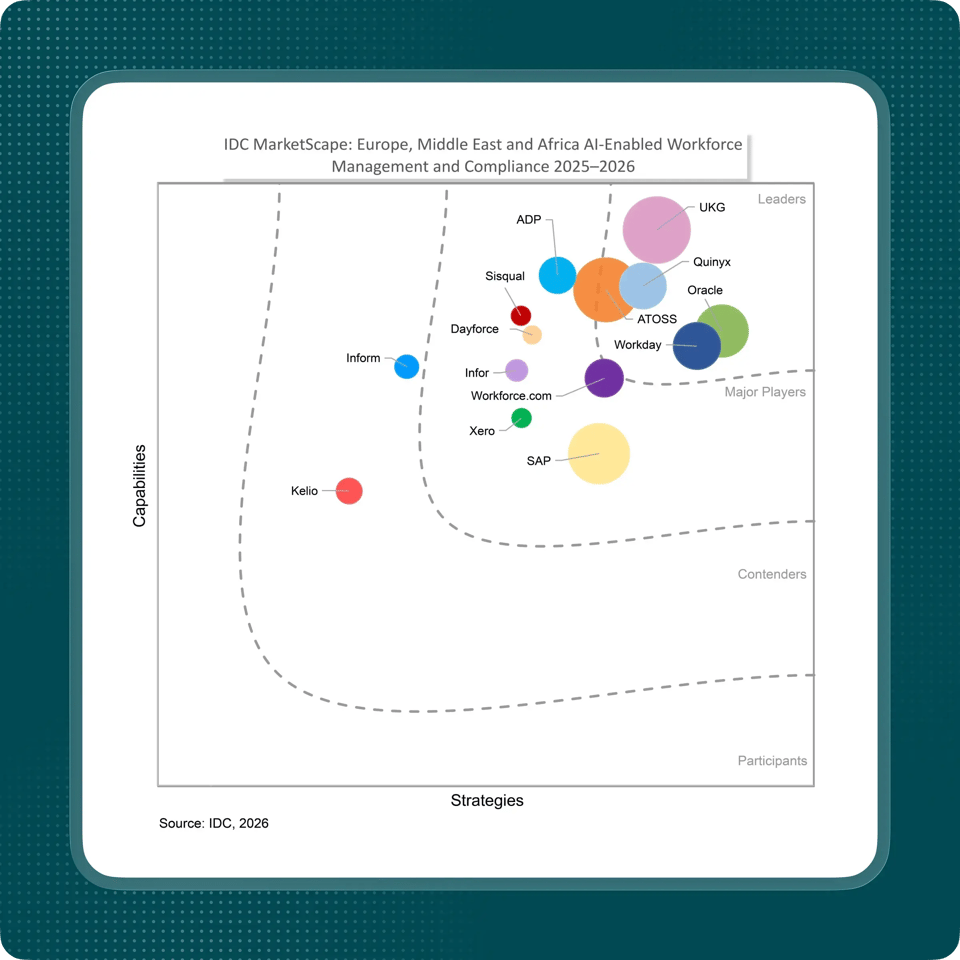
IDC MarketScape vendor analysis model is designed to provide an overview of the competitive fitness of ICT suppliers in a given market. The research methodology utilizes a rigorous scoring methodology based on both qualitative and quantitative criteria that results in a single graphical illustration of each vendor’s position within a given market.

The Capabilities score measures vendor product, go-to-market and business execution in the short-term. The Strategy score measures alignment of vendor strategies with customer requirements in a 3-5- year timeframe. Vendor market share is represented by the size of the circles. Vendor year-over-year growth rate relative to the given market is indicated by a plus, neutral or minus next to the vendor name.