


Skip to content
Scheduling
Scheduling with control over compliance and costs
Time & Attendance
Time-clocking, leave management and payroll integrations
Analytics
Real-time visibility into scheduling, attendance, and labour data to drive smarter decisions
Forecasting
Accurate and hyperlocal forecasting driven by AI

Scheduling Automation
Automated scheduling optimized to your business needs

Operational Insights
Improve decision making with greater visibility into workforce management data


Employee Hub
Employee Hub, the central place for tasks, communications, updates and resources.
Messenger
Elevate communication and collaboration between frontline workers
Feedback and Recognition
Engage and motivate your frontline workforce
Task Management
Manage and track tasks alongside schedules in one place

Recognized in Gartner® Market Guide for Retail Workforce Management Technology

Recognized in Gartner® Market Guide for Retail Workforce Management Technology

IDC Feature
Gartner® Market Guide 2026

Recognized in the Gartner® Market Guide for Retail Workforce Management Technology

Stores are taking on more fulfillment work, and legacy WFM can't keep up. The Gartner® Market Guide for Retail Workforce Management Technology looks at how AI-enabled WFM platforms help retailers close skills gaps, forecast in real time, and keep stores running with less manual oversight.

  • Why AI-enabled skills management is projected to fill 40% of open shifts autonomously by 2028
  • How edge and IoT data are becoming a core input for labor forecasting and intraday task allocation
  • Where governed AI assistants are already reducing manager workload in stores today 

Get the Gartner report - see where retail WFM is headed and where Quinyx fits.

Key findings from this report

calendar-check-2

By 2028, AI-enabled skills management is projected to fill 40% of open shifts autonomously, matching certifications like bakery or pharmacy to associate preferences.

trending-up-1

By 2028, edge analytics (computer vision, IoT) will supply over 40% of the signals feeding labor forecasts and intraday task allocation.

users-2

67% of CIOs plan to increase investment in associate-facing GenAI assistants this year (Gartner 2026 CIO and Technology Executive Survey).

unplug

By 2027, over half of Tier 1 unified commerce retailers will consolidate scheduling, tasking and frontline communications into one associate-facing app.

What’s inside the 2026 retail Market Guide

The Market Guide maps where retail WFM is headed next: AI-driven forecasting, automated scheduling and skills-based matching as the near-term foundation; WFM expanding to work alongside POS, IoT and fulfillment systems to react to demand in real time; and governed AI assistants giving associates in-flow guidance while keeping humans in control of higher-risk decisions. It closes with Gartner's recommendations for CIOs and a representative list of retail WFM vendors by region, including Quinyx.
Gartner_retail_guide_bento-less-white-space

Why retail WFM is no longer just about the schedule

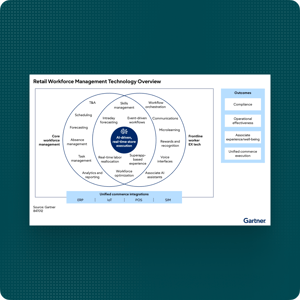
Stores have become fulfillment hubs, and associates now juggle more tasks, systems and complexity than legacy WFM was built for. Gartner's Market Guide confirms the shift: forecasting, scheduling and task management are converging with real-time store data, and AI is moving from a scheduling add-on to the operational core. It's independent evidence of a change Quinyx has been building toward.

Gartner_market_guide_2026_graph_v1

What our customers are saying

About this research

Gartner published the Market Guide for Retail Workforce Management Technology on 4 March 2026 (ID G00847012), authored by Kelsie Marian and Josie Xing. The report covers mandatory retail WFM capabilities - time and attendance, absence management, scheduling, task management and reporting - and names representative vendors across the Americas, EMEA and APAC, including Quinyx, recognized in five consecutive Gartner Market Guides for retail WFM.

Gartner is a registered trademark of Gartner, Inc. and/or its affiliates. This research reflects the opinions of Gartner's research organization and should not be construed as statements of fact.

A store employee wearing an apron shows a red and black cycling shoe to a customer inside a bicycle apparel shop.

FAQ

What is retail workforce management (WFM) software? Software that manages scheduling, time tracking, absence management and task coordination for in-store associates - usually via mobile, POS, tablet or kiosk devices.
What is a Gartner Market Guide? A research report that gives an overview of an evolving market and a representative - not ranked - list of vendors. Unlike a Magic Quadrant, it doesn't score vendors against each other.
Is Quinyx ranked in this report? No - Market Guides don't rank vendors. Quinyx is named as a representative EMEA-headquartered provider.
Which other WFM vendors are named in the Gartner Market Guide for Retail WFM? Gartner's report lists representative vendors across three regions. Americas: ADP, Blue Yonder, Dayforce, Infor, Legion, Logile, StoreForce, TCP Software, UKG, WorkAxle, Workday, Workforce.com and Zebra Technologies. EMEA: ATOSS, aTurnos, Cegid, Protime, Quinyx, SISQUAL WFM, Sona Technologies, Spica International and tamigo. APAC: Deputy, Humanforce and Roubler.
Does the Gartner Market Guide rank Quinyx against vendors like UKG, Dayforce or Rotageek? No. Gartner Market Guides list representative vendors without scoring or ranking them against each other. The report groups vendors by headquarters region and regional focus rather than by performance - Quinyx is listed as headquartered in Sweden/the U.S., with a regional focus on Europe and North America.
What's the difference between an AI assistant and an AI agent? An AI assistant augments human work and needs human interaction to act. An AI agent operates with a degree of autonomy - deciding and acting toward a goal within set guardrails.
What are the mandatory features of retail WFM? Time and attendance, absence management, attestation, flexible scheduling, analytics and reporting, and task management and communications.
How is AI changing retail workforce management? It's moving from forecasting and recommendations a manager has to approve, toward early agentic capabilities that can autonomously handle low-risk tasks like filling shifts or approving routine absences.

Gartner, Market Guide for Retail Workforce Management Technology, Kelsie Marian, Josie Xing, 4 March 2026

Gartner is a trademark of Gartner, Inc. and/or its affiliates. 

This graphic was published by Gartner, Inc. as part of a larger research document and should be evaluated in the context of the entire document. The Gartner document is available upon request from Quinyx. 

Gartner does not endorse any company, vendor, product or service depicted in its publications, and does not advise technology users to select only those vendors with the highest ratings or other designation. Gartner publications consist of the opinions of Gartner’s business and technology insights organization and should not be construed as statements of fact. Gartner disclaims all warranties, expressed or implied, with respect to this publication, including any warranties of merchantability or fitness for a particular purpose.